
What Size Electric Scooter Motor Do You Need?
A wattage number on a spec sheet does not tell you whether an electric scooter will handle your hills. Rider weight, motor performance, and whether the rating is nominal or peak decide that — here is how higher watts actually translate into real hill performance, before you buy.
There is no single wattage that fits every rider. Start with nominal (continuous) motor power and the model’s tested gradeability; then account for rider weight, cargo and the steepest regular hill. Use the ranges below as starting guidance, not a guarantee, and compare nominal watts with nominal watts—not with a peak rating.
01What Motor Power Ratings Actually Mean
A listing may emphasize peak power while another reports nominal (continuous) power. Those figures are not directly comparable. Before choosing, check which rating is being quoted and, for a dual-motor model, whether the number is per motor or combined system output. The ratio between peak and nominal ratings varies; there is no universal multiplier.
When a product title and specification table show different wattage figures, first check whether one is nominal and the other peak. Neither number is useful for comparison until you know the rating type, whether the value is per motor or combined, and what the manufacturer says it can sustain.
- Nominal (continuous) power predicts sustained hill-climbing; peak power predicts a burst of acceleration.
- Do not compare one scooter’s peak watts with another scooter’s nominal watts; check per-motor versus combined output too.
- Torque depends on motor design and setup. Levy Electric gives 20–25 Nm at 250W and 40–50 Nm at 500W as examples; check the exact model where torque is published.
| Published power example | Typical torque in cited source | How to use it |
|---|---|---|
| 250W motor | 20–25 Nm | Illustrative source example; verify the exact motor |
| 500W motor | 40–50 Nm | Torque and climb performance still vary by design and load |
| Higher output or dual motor | Varies by model | Use model-specific torque and gradeability data |
02How Much Power You Need for Your Size and Local Hills
Manufacturer gradeability ratings describe a tested slope, not a guarantee for every rider. Levy Electric notes that tests commonly use a 165 lb rider and estimates that each additional 20–25 lb can reduce effective gradeability by roughly 2–3 percentage points. Treat that as a practical estimate from the cited source—not a universal conversion—and check the test rider, surface, battery state and load for the specific model.
To put a grade percentage in context, a 10% grade means climbing 10 feet for every 100 feet traveled. To estimate your route’s steepest incline, check an elevation profile or measure the grade directly; a short steep driveway can matter more than the route average.
| Grade you ride | Recommended nominal power | Rider-size adjustment |
|---|---|---|
| 0–10% (flat to gentle) | No universal power cutoff | Compare test load and intended use |
| 10–15% (typical hills) | 350–500W | Compare test load with yours |
| 15–20% (steep residential) | 500–700W | Compare tested load and grade |
| 20–30% (very steep) | 1,000–1,500W | Verify test conditions and payload |
| 30%+ (extreme grades) | 1,500W+ or dual motor | Use model-specific manufacturer data |
The other half of the equation is your total load against the scooter’s rated maximum. Count the rider, clothing, bags and any accessories, then compare that total with the manufacturer’s payload limit. A scooter may support a load on level ground but perform differently on a climb; look for gradeability tests using a load close to yours. If the test conditions are not disclosed, treat the published grade as a rough comparison rather than a promise.
03Single Motor vs. Dual Motor: What Actually Changes
A dual-motor scooter is not simply “twice as fast.” Adding a second drive motor can change available output, traction and weight, but the result depends on the motor and controller setup; it is not a simple speed multiplier.
| Mechanism | Single motor | Dual motor |
|---|---|---|
| Total power available | Limited to one motor’s rating | Combined output from two motors |
| Traction on loose or wet surfaces | One powered wheel provides drive | Two driven wheels may help; surface and controls matter |
| Hill-climbing under load | One motor supplies propulsion | Drive can be shared; battery and controller still cap output |
| Weight and energy use | Often simpler; check the actual model weight and range | Extra hardware can add weight; use-mode and terrain affect range |
| Redundancy | One drive motor | Do not assume one motor can carry you after a fault |
The useful comparison is not “one motor versus two” in isolation. Check the system’s nominal output, tested gradeability, payload and total weight together. A dual-motor label does not guarantee a particular speed, climb or range; those results depend on the controller, battery, tires, load and test conditions for that specific model.
04What Top Speed Can (and Can’t) Tell You
Wattage and top speed are related, but a motor rating alone does not determine how fast a scooter will travel. Controller limits, battery state, tire size, rider and cargo weight, and terrain all matter. Use the checklist below to compare like with like instead of treating a headline speed as a guarantee.
| Specification | What it tells you | What to verify |
|---|---|---|
| Nominal (continuous) watts | Rated sustained motor output | Per motor or combined system output? |
| Peak watts | Short-duration maximum | Do not compare it directly with nominal watts |
| Gradeability | Claimed climb performance | Test rider, load, surface and battery state |
| Maximum payload | Manufacturer’s load limit | Include rider and carried cargo |
| Top speed and range | Test-dependent performance | Rider weight, terrain, mode and test conditions |
Choose a motor for the hills and total load you actually ride with. Do not select a scooter from its top-speed figure alone, and do not assume that two products tested under different conditions are directly comparable.
05Check a Current Product Listing
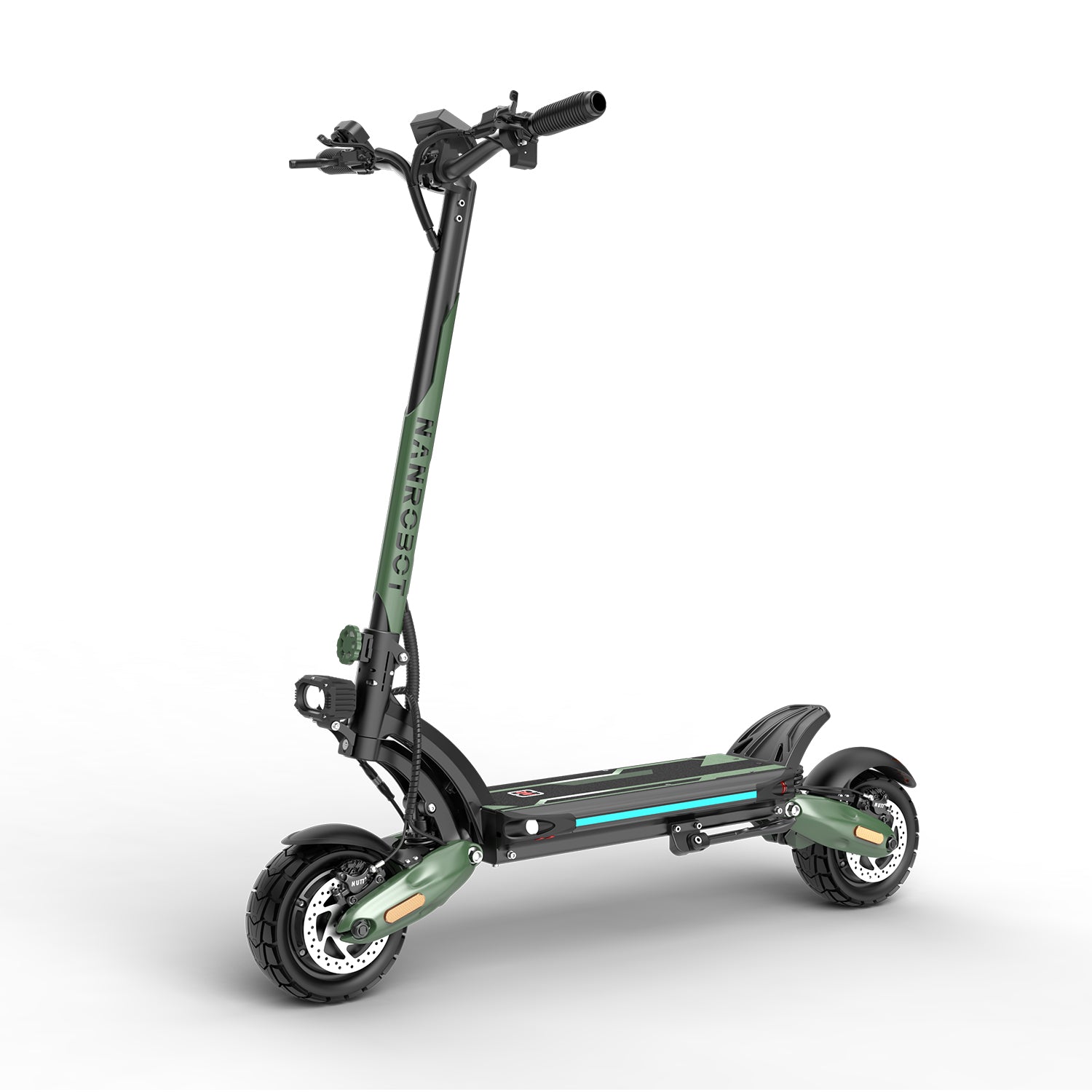
VoltTrek’s live catalog currently includes the NANROBOT D6+ MAX electric scooter. Use its current product page to confirm the specifications and availability shown for that exact model; this guide does not treat an old product example or a wattage headline as a sizing recommendation.
- Confirm whether the motor rating is nominal or peak, and whether a dual-motor figure is per motor or combined.
- Check the gradeability test conditions and compare the test load with your rider weight and cargo.
- Use the manufacturer’s documentation for model-specific performance claims; if test conditions are missing, ask before relying on them.
06Signs Your Motor Is Undersized
An undersized motor does not fail quietly — it tells you, usually on the first real hill. Before you assume it’s a battery problem, consider whether the motor itself is the real bottleneck.
- Progressive speed loss on a climb instead of holding steady speed, even at full throttle.
- Noticeable heat coming from the motor hub or deck after a sustained hill — a sign the controller is working past its comfortable range.
- Faster-than-expected battery drain on hilly routes; climbing already uses 40% more energy than flat riding, per Levy Electric’s testing, and an undersized motor compounds that by staying at maximum output longer.
- Thermal cutoff or sudden power reduction partway up, which can happen abruptly and is a genuine safety concern in traffic.
- Struggling to restart from a dead stop partway up a hill, rather than just slowing down.
If these symptoms persist, have the scooter inspected and compare its published gradeability with your route and load. A maintenance or battery issue can produce similar symptoms, so do not assume that a larger motor is the only fix.
07FAQ: Electric Scooter Motor Sizing
What size electric scooter motor do I need for hills?
As a rough guide from Levy Electric, 350–500W nominal may suit 10–15% grades, 500–700W for 15–20%, and 1,000–1,500W for 20–30%; steeper grades may call for 1,500W+ or dual motors. These are broad estimates, not guarantees. Check the manufacturer’s gradeability test and load for the exact model.
Is 500W enough for an electric scooter?
It can be enough for many flatter commutes, but wattage alone cannot answer that. Check whether 500W is nominal or peak, then compare the model’s payload and gradeability test with your rider weight, cargo and regular hills.
Do I need a dual motor scooter?
Not automatically. Two motors may help with traction or climbing, but the benefit depends on the controller, battery, tires and tested load. Compare those specs with your route and payload; the second motor also adds hardware, so it is not a universal upgrade.
What’s the difference between nominal and peak motor wattage?
Nominal (continuous) power is the sustained rating; peak power is a short-duration maximum. There is no universal multiplier between them. For sustained climbing, compare nominal ratings and the manufacturer’s gradeability test, not a product-name wattage alone.
Does rider weight really change gradeability that much?
Yes. Levy Electric estimates that each additional 20–25 lb beyond a typical 165 lb test rider can reduce effective gradeability by about 2–3 percentage points. That is a general estimate, not a model-specific result; use the manufacturer’s own test conditions when available.
Will a bigger motor drain the battery faster on flat ground?
Motor count or peak wattage alone does not determine range. Battery capacity, system efficiency, speed, rider and cargo weight, tires, riding mode and terrain all matter. Hills require more energy than flat travel, but compare range claims only when the test conditions are similar.
- Levy Electric — “Understanding Gradeability in Electric Scooters,” published Jan. 10, 2024, updated Oct. 30, 2025.
- Engineer Fix — “What Does Road Grade Mean and How Is It Calculated?,” published Jan. 9, 2026.


