
Commuter Scooters With a Handbrake: Brake Types Compared
On an electric scooter the handbrake is the service lever, and whatever that lever pulls on decides how quickly you stop. Here is how the families differ, what rotor and piston numbers actually change, and what to inspect on a scooter you use every day.
A scooter handbrake is the service stopping assembly, operated by a lever on the handlebar, one for the front wheel and one for the rear. That lever pulls a cable on a mechanical disc, pushes fluid through a hose on a hydraulic disc, or expands shoes inside a drum. Sizing is set by the rotor and caliper: kits in our range use 180 mm rotors with 2-piston calipers for machines listed at 500–1000 W, and 203 mm rotors with 4-piston calipers on the higher-output sets, listed per kit from 500 W and above to 750 W and more.
01What a Handbrake Actually Does on an Electric Scooter
A scooter handbrake is the lever that applies the service brake, front and rear, and it is the control you use for every stop. It is not a parking brake: the lever presses a pad or shoe against a rotating surface, and the friction slows the wheel. On a kick scooter the only stopping force is a foot on the ground or a step-on rear fender, which is why the handbrake is the feature that separates a commuter scooter with handbrake control from a toy. Materials and build quality differ too: the two wheels carry the rider, the frame carries the load.
What the lever acts on is what separates one scooter from another. Cable-actuated mechanical discs transmit force through a steel cable; hydraulic setups transmit it through fluid in a sealed hose; drum units push shoes outward against the inside of a rotating drum. Many electric scooters also slow the wheel with the motor itself, and the market offers models aimed at adults as well as lightweight folding designs for mixed train-and-ride commutes, and on a hydraulic kit from a modern e-drive the lever can cut motor power through a sensor connector the moment you pull it — the TEKTRO set in our range carries a 300 mm 3-pin male waterproof connector for exactly that job.
Two levers, two wheels, one behaviour to learn: squeezing both evenly keeps the scooter settled, and grabbing only the front on a wet surface is how riders lose the front wheel. The standing deck, the tire choice and the folding mechanism all change how a scooter feels in traffic, but the amount of grip available on the ground is set by the tires — and the handbrake can only use the grip that is there. That behaviour is the same whatever the mechanism, which is why the practical comparison is not “which lever is nicer” but “what does the lever act on”.
- The handlever applies the service stopping assembly; a parking brake is a separate feature.
- Cable, hydraulic and drum hardware differ in how force reaches the pad or shoe.
- A sensor connector can cut motor power as the lever is pulled.
From lever to pad: the parts in the chain
Every scooter’s stopping hardware has the same chain of parts. The lever at the handlebar converts your hand into force. That force travels through a cable or a hydraulic hose to a caliper mounted on the fork or the frame. Inside the caliper, one or more pistons push pads onto a steel rotor fixed to the wheel. The pads wear, the rotor stays, and the mounts that hold the caliper come in two standards — IS and Post Mount — which is why the kits are sold with adapters rather than as a universal fit.
02Brake Types Compared
Kick scooters and small-wheeled commuters rarely carry hydraulic hardware at all, and that is the honest dividing line: the mechanism follows the speed and the weight. Mechanical discs are cheap, simple and adjustable with a cable; hydraulic discs move more force for the same hand effort and self-adjust as pads wear; drum units are sealed from weather and need less attention; motor braking adds drag without friction. Which one suits a scooter depends on weight, speed and how often you ride in the rain.
The trade-offs are practical rather than mysterious. A cable stretches and needs periodic tensioning; a hydraulic setup is sealed, so it needs proper bleeding when serviced rather than routine adjustment. A drum unit survives wet roads well and fades less suddenly, but it is heavier and harder to inspect. Motor braking, sometimes called regenerative braking, recovers some energy on long descents and reduces pad wear, but it cannot be the only setup you rely on — friction is what stops a scooter when the battery is full or the controller cuts out.
| Type | How it is actuated | Maintenance pattern | Where it suits a scooter |
|---|---|---|---|
| Mechanical disc (cable) | Steel cable from the lever to the caliper | Cable tension and pad wear | Lighter scooters, simple DIY service |
| Hydraulic disc | Fluid pushed through a sealed hose | Pads and fluid, no cable stretch | Heavier scooters and higher speeds |
| Drum | Shoes expanded inside a drum | Shoes, sealed from weather | Wet climates, low-maintenance builds |
| Motor (regenerative) braking | Controller reverses motor drag | Software setting, no friction parts | Long descents, extending pad life |
03Piston Count and Rotor Size: What the Numbers Mean
Piston count and rotor diameter are the two numbers that decide how much braking force a kit can produce. A larger rotor gives the caliper more leverage and more surface to dissipate heat; more pistons spread that force across a wider pad area, which matters on heavy scooters and long descents.
Our own range shows the split clearly. The EUNORAU 2-Piston 2.0 Hydraulic Kit uses 2-piston hydraulic calipers on 180 mm rotors with 1050 mm and 1980 mm hoses, and is listed for scooters and e-bikes equipped with 500 W, 750 W or 1000 W power and below, with TEKTRO E10.11 as a replacement pad reference. The EUNORAU 4-Piston Hydraulic Kit moves to 203 mm rotors with an adaptor bracket for IS and Post Mount, listed for 750 W or 1000 W and more, with SHIMANO D02S and D03S pads. The TEKTRO 4-Piston set combines 203 mm rotors, both Post Mount and IS adapters, and that 300 mm 3-pin waterproof connector.
| Kit | Rotor | Caliper | Listed for | Replacement pads |
|---|---|---|---|---|
| EUNORAU 2-Piston 2.0 | 180 mm | 2-piston hydraulic, IS and/or Post Mount | 500 W, 750 W, 1000 W and below | TEKTRO E10.11 |
| EUNORAU 4-Piston | 203 mm | 4-piston hydraulic, IS and Post Mount adaptor | 750 W or 1000 W and more | SHIMANO D02S & D03S |
| TEKTRO 4-Piston | 203 mm | 4-piston hydraulic, Post Mount + IS adapters | 500 W and above | See kit listing |
Read those rows as a matching exercise rather than a ranking. A 2-piston kit with 180 mm rotors is what the catalogue recommends for scooters up to 1000 W — which covers a great many commuter machines — while the 4-piston and 203 mm hardware is aimed at the heavier, faster end. Fitting bigger brakes than the scooter can use adds unsprung weight and can overpower a tire before the traction is there; fitting smaller ones on a 3000 W scooter is the mistake with real consequences.
Mounts, hoses and pads: the details that decide if a kit fits
Before ordering any hardware, match three details to your scooter: the caliper mount standard (IS or Post Mount — the kits here include adapters to cover both), the hose or tube length you need to reach from the lever to the caliper, and the pad reference so replacements are a known part number. The rotors themselves are consumables too: 180 mm and 203 mm rotors are not interchangeable without the right adapter.
04What Matters on a Daily Commute
For everyday riding, three things matter more than the brake brand: consistent stopping in the wet, predictable behaviour on descents, and pads you actually inspect. A commuter route with hills loads the stopping hardware far harder than a flat one, and a scooter carrying a heavier rider plus a bag needs more stopping force for the same stop.
Weight is stated on the product pages for a reason. The scooters in our range are listed with maximum loads of 265 lb and 330 lb depending on the model, on dual motors from 1200 W × 2 to 3000 W × 2 with 10″ to 11″ tires and hydraulic discs fitted as standard. Ride with the scooter near its stated load limit and the discs work hardest exactly when the rider has least margin — so the sensible habit is to inspect pad thickness on the same schedule as the tires, and to test both levers before the first ride of the week.
05Matching Brakes to Your Scooter and Load
Start from the motor and the load, then work back to the stopping hardware. A scooter with dual 1200 W motors and a 265 lb limit sits in a different braking bracket from a 3000 W machine rated for 330 lb, and the catalogue states the difference in watts, rotor size and piston count rather than in adjectives.
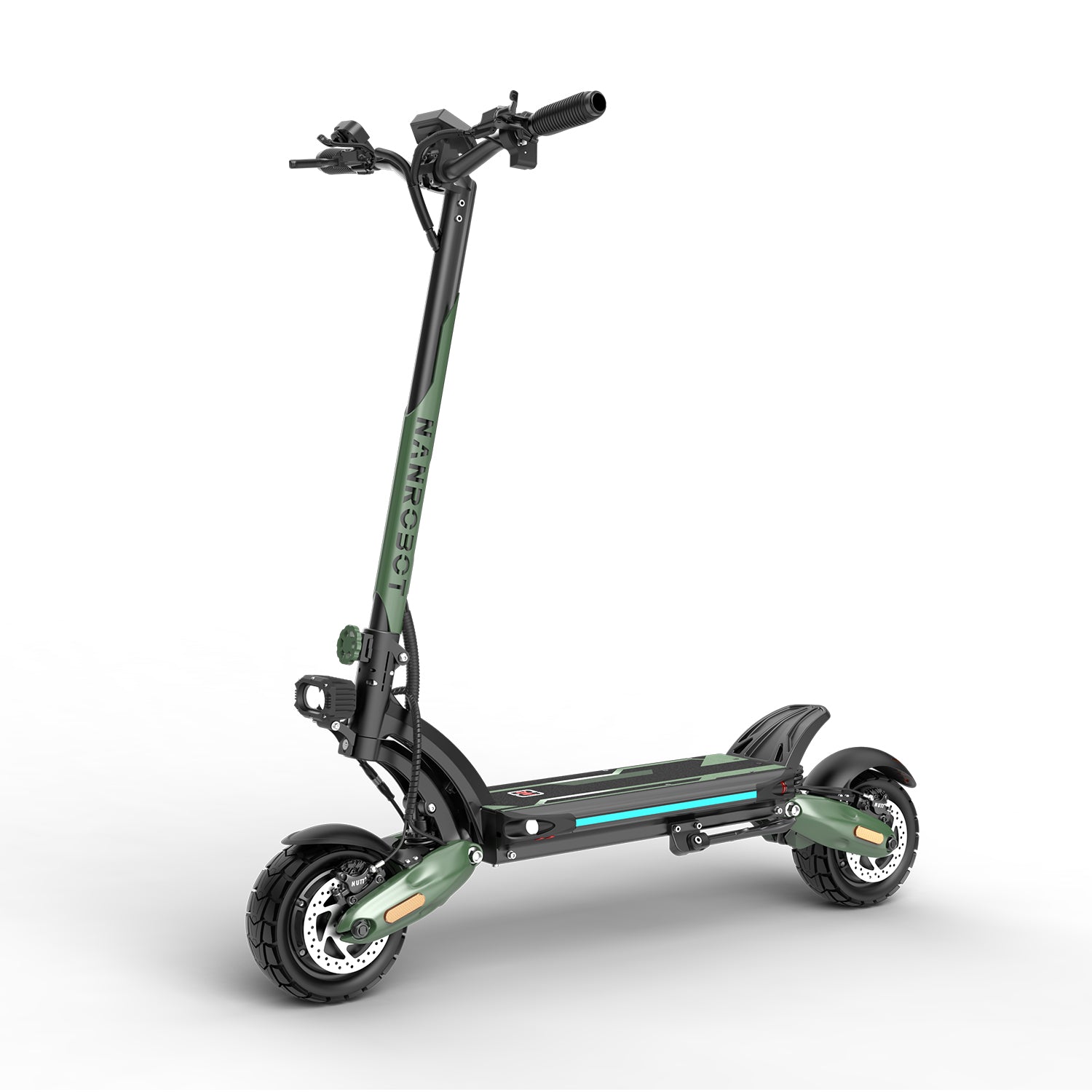
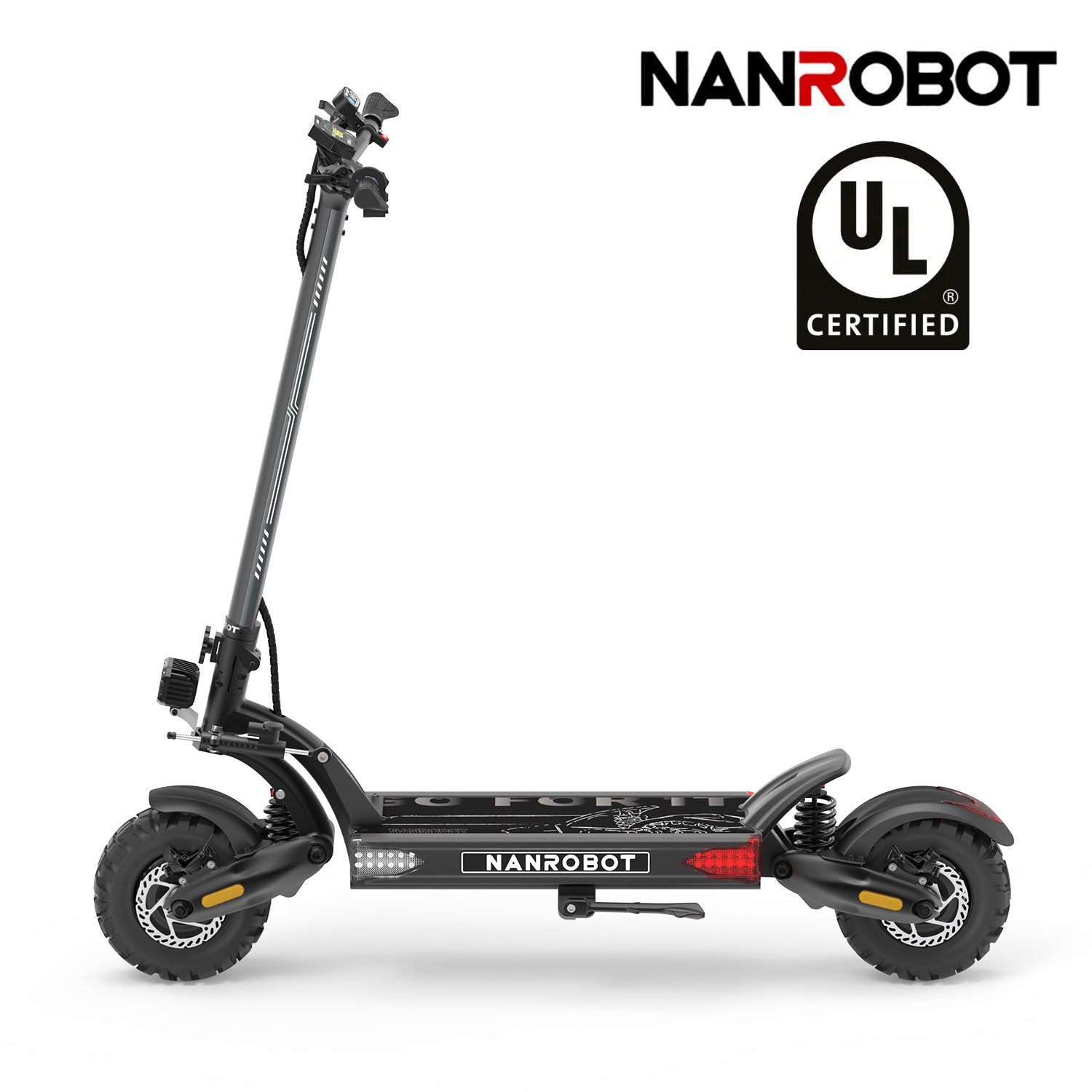
Dual 1500 W motors (3000 W peak), 60 V 30 Ah, 10″ tires, hydraulic discs, 330 lb stated load.
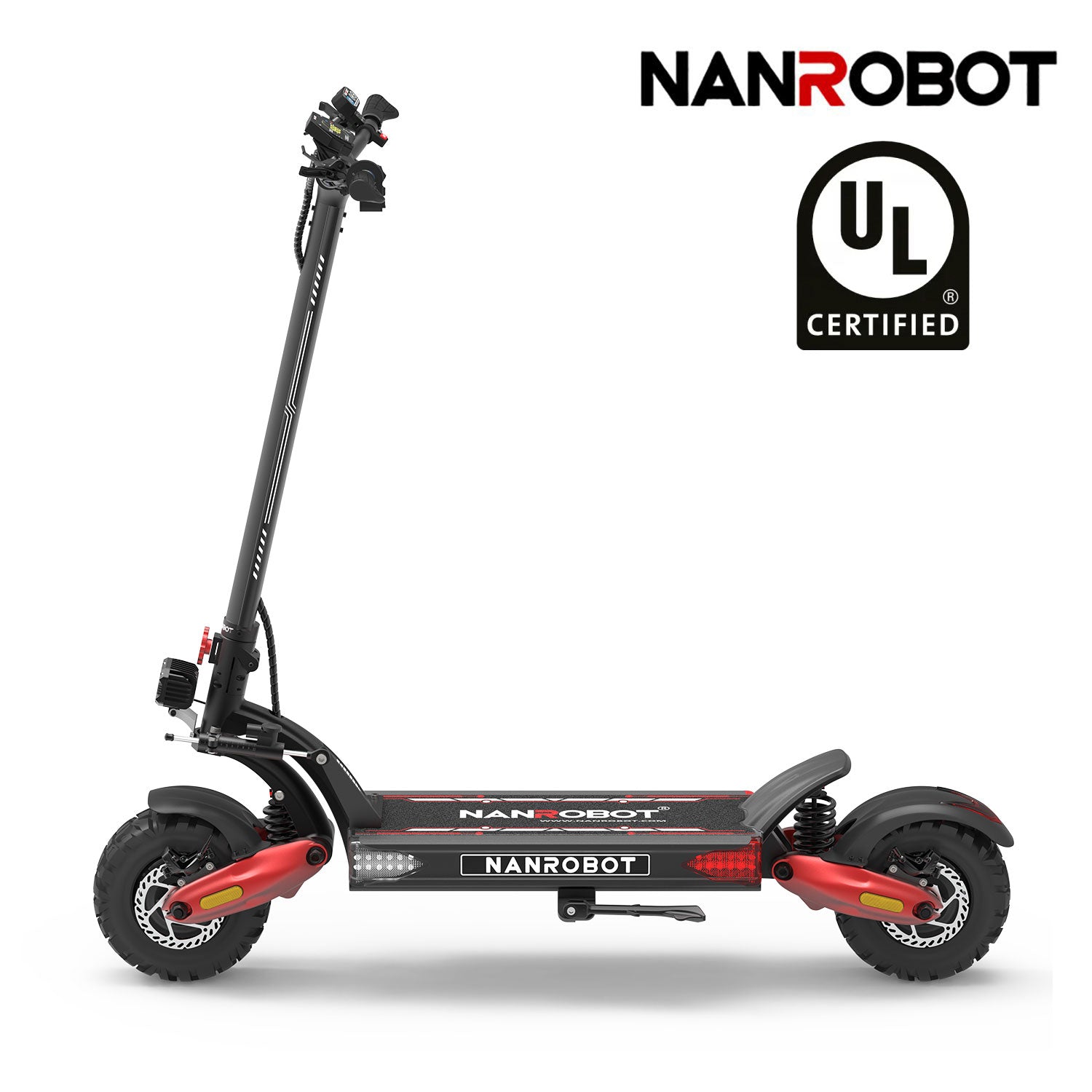
Dual 3000 W motors (6000 W peak), 72 V 35 Ah, 11″ tires, hydraulic discs, 330 lb stated load.

2-piston calipers, 180 mm rotors, IS and/or Post Mount, listed for 500–1000 W machines.

4-piston calipers, 203 mm rotors, IS and Post Mount adaptor, listed for 750–1000 W and more.
Two more models round out the range for riders comparing motor output first: the NANROBOT D4+ MAX with dual 1200 W motors and a 265 lb stated load, and the NANROBOT N6 with dual 1500 W motors on a 72 V battery. Both are listed with hydraulic discs as fitted equipment, which keeps the comparison about rotor and pad service rather than about the family.
06Daily Handling: Folding, Carrying and the Numbers to Compare
Commuting with a scooter is as much about the frame as the stopping system. A lightweight folding frame with a foldable stem that folds in seconds is convenient on a mixed train-and-ride commute, and parking it at the office or in a hallway is easier when the aluminum deck and stem collapse to a manageable size.
The number to compare first is the rider load; these figures and part numbers matter side by side when you shop: the tire size (10″ or 11″ on the models here), the stated maximum load (265 lb or 330 lb), the motor output, and the braking hardware listed with the scooter. Over years of urban rides, the parts that decide whether the trip stays smooth are the tires, the bearings and the pads — which is why reference numbers such as TEKTRO E10.11 or SHIMANO D02S matter beyond the workshop. A commuter scooter with handbrake control, a section of deck you can stand on comfortably and a folding mechanism that locks securely covers the practical side of the decision.
The safety side is the same checklist in miniature: even braking, both levers working, no play in the steering, and a folding clamp that stays closed. The features that matter most in daily use are the ones you notice on a wet morning: features such as a sensor connector that cuts motor power, or hydraulic calipers with alloy bodies in place of cable discs, change how the scooter feels on the road far more than their price difference suggests.
07Frequently Asked Questions
Do electric scooters have handbrakes?
Yes. A scooter is braked by levers on the handlebar, one for the front wheel and one for the rear, and those levers are the service brakes you use at every stop. What the lever acts on varies: a cable to a mechanical caliper, fluid to a hydraulic caliper, or shoes inside a drum. Many scooters also add motor drag through the controller.
Are hydraulic discs better than mechanical discs on a scooter?
Hydraulic brakes move more force for the same hand effort and do not lose performance to cable stretch, which is why they appear on heavier and faster machines. Mechanical cable discs remain common on lighter scooters because they are simple to adjust on the roadside. The catalogue splits them by power: 2-piston hydraulic kits with 180 mm rotors are listed for 500–1000 W machines, while the 4-piston kits with 203 mm rotors are listed from 500 W and above, with the EUNORAU set specified for 750 W and more.
How often should scooter pads be replaced?
It depends on load, terrain and how hard you brake, so the reliable rule is to inspect rather than to count months. Inspect pad thickness monthly, verify cable tension weekly on a mechanical disc, and replace pads when the friction material is close to the backing plate. Reference pad numbers make the job predictable: TEKTRO E10.11 for the 2-piston kit, SHIMANO D02S or D03S for the 4-piston kit.
- VoltTrek product data for the EUNORAU 2-Piston 2.0 Hydraulic Kit with 180 mm disc rotors (2-piston calipers, IS and/or Post Mount, 1050 mm + 1980 mm hoses, 500–1000 W, TEKTRO E10.11 pads). volttrek.store, verified 14 September 2026.
- VoltTrek product data for the EUNORAU 4-Piston Hydraulic Kit with 203 mm disc rotors (4-piston calipers, IS and Post Mount adaptor bracket, 750 W or 1000 W and more, SHIMANO D02S & D03S pads). volttrek.store, verified 14 September 2026.
- VoltTrek product data for the TEKTRO 4-Piston Hydraulic Kit with 203 mm rotor (Post Mount and IS adapters included, 300 mm 3-pin male waterproof connector). volttrek.store, verified 14 September 2026.
- VoltTrek product data for the NANROBOT D6+ MAX, D4+ MAX, N6 and LS7+ electric scooters (dual-motor output, battery, tire size, hydraulic discs, stated maximum load). volttrek.store, verified 14 September 2026. These figures are published as dealer-supplied specifications. Rider age and licensing rules, where they exist, are set locally.
- Limits of this review: road rules for electric scooters differ by state and city, including where they may be ridden, and those rules are [A VERIFIER] for your own location and should be confirmed with your local authority before you ride.


